Blog

  • TCO of MPLS-TP versus IP/MPLS

    ACG Research has done an interesting TCO of MPLS-TP versus IP/MPLS showing there is a huge reduction of  Total Cost of Ownership (TCO) in MPLS-TP versus IP/MPLS.  The analysis was done in two environments: Native Packet transport  on MPLS-TP versus IP/MPLS  and second one using TDM/Packet mix on MPLS-TP versus Circuit emulation on IP/MPLS.  The platform used for  MPLS-TP was from ECI Telecom.  Further and most importantly Mobile backhaul was chosen as the network for analysis purpose.

    https://www.acgresearch.net/tcos/eci-telecom’s-mpls-tp-npt-solution.aspx

    The analysis proved a couple of  things:

    1. The TCO ( CAPEX and OPEX) over 5 years  for pure packet transport using MPLS-TP is 55% lower compared to IP/MPLS.

    2. When TDM services were added to the network. CAPEX on ECI NPT solution increased by 5% while the Circuit emulation addition on IP/MPLS increased its CAPEX by 37%. The 55%  OPEX saving in the first study increased to 64% when TDM traffic was added.

    The high reason for the OPEX on IP/MPLS was attributed to the need for highly skilled technical staff needed to maintain IP/MPLS network compared to MPLS-TP.

    Among OPEX, things like Network care, training, Network patches and upgrade, Cooling cost, Power cost, Service contract were compared. In all cases the OPEX cost for MPLS-TP were lower compared to IP/MPLS.

    The results thus proved that MPLS-TP being a simpler technolgy contribute to much lower OPEX and CAPEX when used in metro networks and as such should be favored by the Operators if deployment is needed in Access or Metro areas.
  • Cloud drives Carrier Ethernet !

    Cloud is driving the Carrier Ethernet evolution. The MEF is serious about the evolution of Carrier Ethernet to meet the new demands of Cloud. The first and foremost would be to understand the elastic and dynamic demands of  Cloud which are pretty new to Carrier Ethernet scheme of things. MEF is trying to see how best the CE can evolve to meet these elastic demands. CE 2.0 has already set the pace. CE 2.0 addressed the major requirement for mobile backhaul in terms of managing Multiple CoS; Secondly, with CE 2.0, the number of services increased from 6 to 8. Two new services were introduced under E-Access. E-Access is needed when there is UNI that needs to be connected to ENNI-something that would be of interest to Cloud service providers e.g if a service provider owns UNI ; it can backhaul multiple cloud services to ENNI. As per MEF, it is targeting two key applications for cloud industry. One to enable private cloud connectivity of business customers through Service Provider’s cloud  and secondly to interconnect data centers of service providers. The first one is of important since business customers would need certain SLA for the connectivity of their mission critical applications. This is where Carrier Ethernet can really help in ensuring the SLA.

  • FAQ about Software-defined networking (SDN)?

    What is SDN?

    Software-defined networking (SDN) is an approach to networking in which control is separated from hardware ( control decoupled from forwarding plane) and given to a software application called a controller.

    What are the issues with today’s networks?

    1. Networks are static: Today’s networks are static; e.g introducing new switches or moving any network element or routers need a lot of involvement of IT in terms touching a lot of  switches, routers, firewall and update ACLs, VLANs, QoS using device level management tools. The software version, hardware version etc need to be taken into account. Therefore today’s network are mainly static. On the hand the network needs are dynamic and growing. Applications today reside on multiple virtual machines ( VMs). VMs migrate to balance the server workloads causing the traffic pattern to change dynamically.
    2. Inability to Scale: Data centers are growing in big numbers and so does their connectivity requirements. Companies such as google and Yahoo are depending on the efficiency of their data centers’ connectivity to provide fast speed processing to the users. As the network grows, the network elements grow tremendously rendering it very difficult for the IT to manage the network manually.
    3. Vendor dependence: Service Providers have to depend on the vendors , their product life cycles and roadmaps to deploy new services.


    How can SDN Help?

    SDN makes the network control decoupled from forwarding and makes it programmable. By this decoupling, IT managers will have full control on the configuration, optimization, management via dynamic SDN programs. This programs are written by service providers themselves and they don’t have to depend on the vendors to develop the products as per their roadmaps. This enables the organization to quickly roll out the services, efficiently control network resources from a central place and cope dynamically with the dynamic demands of the network which otherwise is not possible with the static networking.

    What is Open Flow ?

    Open Flow is a protocol through which SDN will be standardized; It is the protocol through which the forwarding plane will be controlled by the Control layer.

  • How is MPLS-TP different from MPLS?

    Given  the attention MPLS-TP has received in the industry, it is worthwhile to discuss how this technology is different from MPLS. So here is a listing of the differences between the two.

    1. MANAGEMENT PLANE SETUP :

    LSPs in MPLS-TP can be setup without the use of control plane purely through the management plane. Quite opposite than MPLS which would need routing protocols or RSVP in case of MPLS-TE to set up LSPs. It is as if someone is sitting in the NOC and provisioning the LSPs from NMS centrally.

    2. BIDIRECTIONAL LSPs:

    Quite common in transport world is to have bidirectional Paths for circuits. In IP world, a traffic setup between two nodes can actually take any path if there is mesh available; not true about MPLS-TP. Though MPLS-TP does support unidirectional LSPs it is the bidirectional LSPs mode for which the transport world will adopt it.

    3. CONTROL PLANE IS NOT MANDATORY:

    MPLS-TP can be run without the assistance of control plane  which is absolutely a MUST HAVE for the MPLS environments. With MPLS-TP paths are setup by the NMS and downloaded into network elements.

    4. IN BAND OAM:

    All the necessary OAM information is carried inside the MPLS-TP frame; this is called in-band and also termed as ” fate sharing”. Again it is different from the MPLS where this OAM info is carried Out of Band.

    5. NO IP FORWARDING:

    MPLS-TP can run in an IP free environment; what does it exactly mean ? In traditional routers the IP is run on the interfaces since there is a need for the exchange of the out-of-band control messages. MPLS-TP can be run without IP in the forwarding plane.

    5. SEPERATION OF MANAGEMENT/CONTROL  AND DATA PLANE

    The failure of control plane in MPLS can affect traffic while this is not true for MPLS-TP. Failure of management plane in MPLS-TP will not affect the data forwarding.

  • Is there a room for 100G Non Coherent Systems ?

    The debate whether there is a market for 100G direct detection systems which are essentially Non Coherent is interesting. ADVA is on one side while the rest of industry on the other side. ADVA has been strongly advocating the need for 100G direct detection trasnponders that can cater to the need of what they call 40 KM to 500 KM market segment. This segment is essentially the metro market where cost matters and that is where the DD (Direct Detection) systems cost wise are much better than the Coherent systems. Coherent systems also generate more heat and need more power – A point highlighted by ADVA.

    ADVA is almost alone in the camp that is advocating the DD systems, while the rest of the market is on the other side. Coherent market thinks that there is an ecosystem for 100G coherent system which will be affected if a competing technology comes in. The whole idea of having one technology is to have economy of scale; once everyone is developing same technology the costs will bring down automatically. That there is no need for a competing technology specially when Coherent systems can give you some low-cost Metro flavours though not at a cost at which DD system sells.

    As an operator, I do have concerns about the cost of Coherent 100g but then there are larger industry interests and that is creating an ecosystem for Coherent 100g components; without the industry focusing on a single technology, there would be a  competition for the market in the metro area between the direct detection and Coherent technologies. This of course does not augur well for the industry in the long-term. I am a firm believer that the cost of coherent will go down in future, if all of us focus on it.  So what do you think about the Coherent versus DD debate, let me know !

  • Why using CE-VLAN ID Preservation matters in Carrier Ethernet?

    Ideally VLAN ID Preservation should be preserved ( CE-VLAN ID = Yes). After all, why it should matter, changing VLAN IDs. Having same VLANs IDs make it operationally efficient for both operator and customer. Operator can trace the circuit well, so can the end customer by just knowing the VLAN IDs. Not to forget that it would be easy to setup such an EVC  since the VLAN ID to EVC map will be much simple in this case.

    In this post I will explain that why it is needed to set VLAN Preservation ID = NO

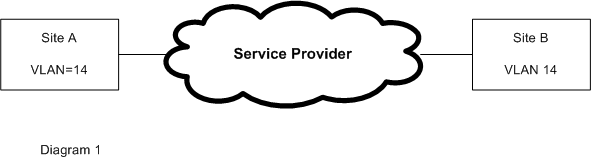
    Let’s see the example of setting VLAN Preservation ID = YES and its advantages. See the diagram 1 below, customer has two campuses with the same VLAN number 14. Obviously this situation demands that VLAN Preservation ID should be set to YES. Why asking the end customer to change VLAN IDs in the first place ?

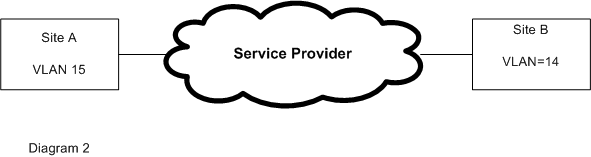
    Lets see a second scenario in which two campuses of the same customer are connected to each other but both have different VLANs. The obvious advantage here for using VLAN Preservation ID= No is to let the service provider do the switch and hence in that case the service provider will switch the VLAN ID from 15 to 14  before handing the traffic to B while the converse will be true when handing the traffic to A. This is shown in diagram 2 below.

  • Five Attributes of Carrier Ethernet

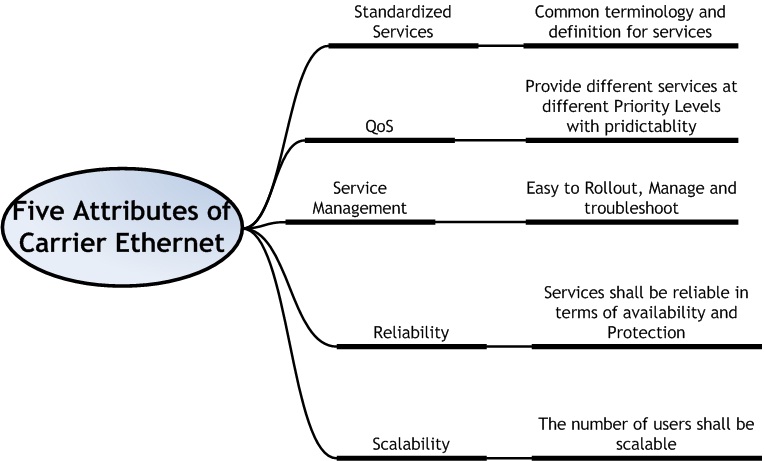
    Carrier Ethernet has five essential attributes that must be met as shown in the following diagramImage